
Amazon Product Photography Cost: What Sellers Pay in 2026
Knowing your real Amazon product photography cost helps you budget before ordering samples. A full 7-image set (pure white hero, dimension callouts, objection-killers, and lifestyle scenes) costs very different amounts depending on whether you hire a freelancer, book a commercial studio, or generate assets from a locked product photo. Here is what each route costs per photo and per SKU.
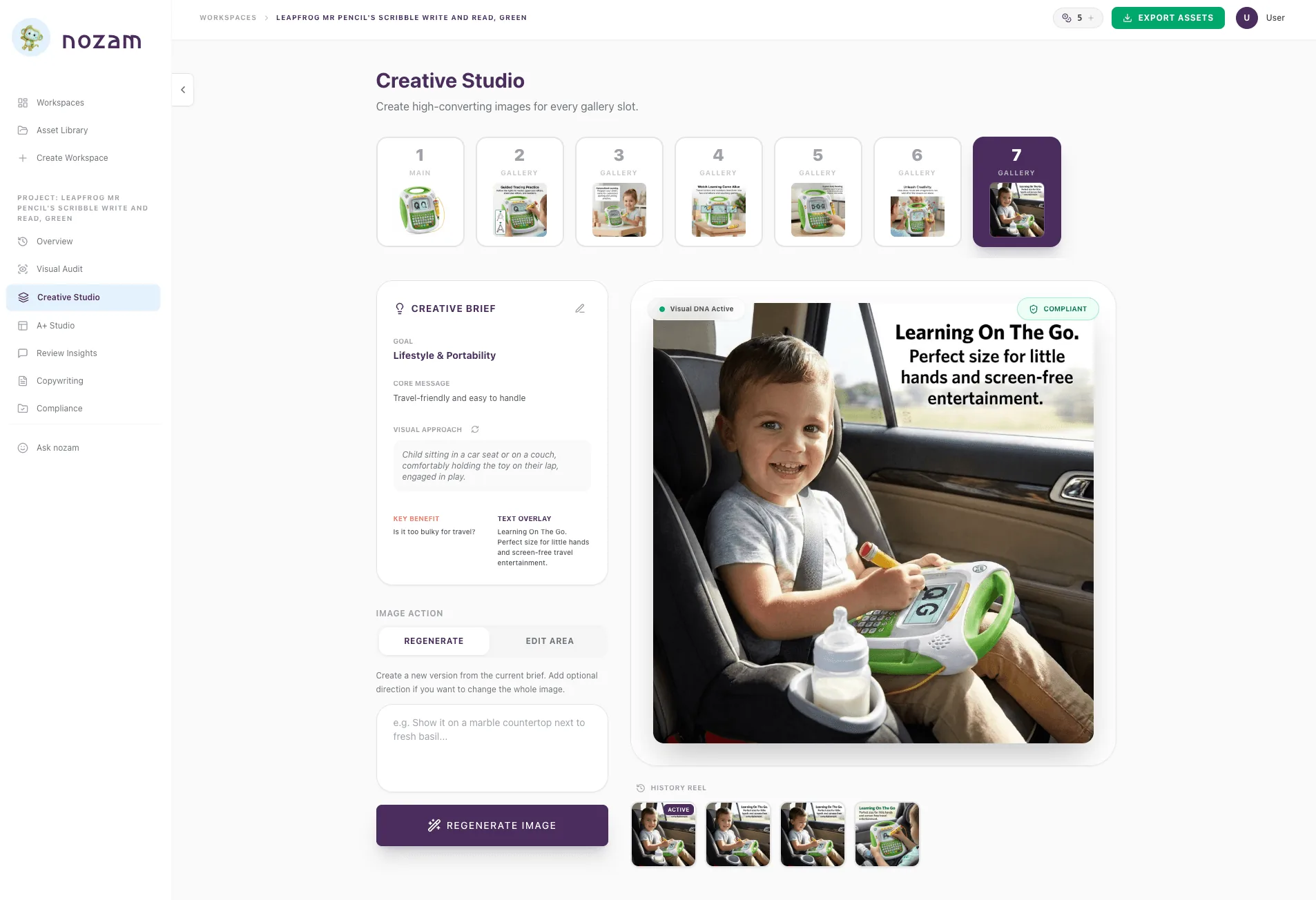

- Step 01Upload photo or import ASINA clear smartphone shot or existing catalog link.
- Step 02Visual DNA™ locks itGeometry, materials, and logo placement are fixed.
- Step 03Export checked assetsCompliance Guard audits every image before download.
Amazon Product Photography Cost Comparison by Route
What you can expect to spend per photo ($25–$350+) and per 7-image SKU package across standard production methods in 2026.
| Production Route | Cost / SKU | Turnaround | Revision Policy | Amazon Policy Verification |
|---|---|---|---|---|
| Marketplace Freelancer (Upwork / Fiverr) | $50 – $350 / SKU | 5 – 14 days | Billed per revision round ($25 – $75) | Manual; seller must audit RGB & ratios |
| Dedicated E-Commerce Studio | $500 – $1,800 / SKU | 2 – 3 weeks | 1 round included; extra shots billed at $75 – $150 each | Good white backgrounds; infographics often require extra copywriter |
| Full-Service Creative Agency | $1,800 – $4,500 / SKU | 3 – 6 weeks | Contracted milestones; scope creep triggers change orders | High production value, but rarely optimizes for Amazon mobile gallery crop |
| In-House Camera + Lightbox Setup | $2,500+ upfront + staff time | Immediate once staged | Free internal labor, but high time investment | Requires Photoshop operator for pure white clipping & RGB 255 clamping |
| nozam (Visual DNA™ + Compliance Guard)MODERN ROUTE | Free Sandbox; ~$3.40 / SKU on Growth | Minutes from 1 photo or ASIN | Instant regeneration using locked product geometry | Automated pre-export audit for RGB 255, 85% fill, and claim rules |
Ranges reflect typical pricing published by e-commerce photography studios, freelancers, and Amazon agencies as of 2026; actual quotes vary by category and revision count. Current nozam pricing is on our pricing page.
The 6 Invoiced Expenses Traditional Studios Rarely Mention
A studio rate card might quote '$40 per photo,' but the actual invoice is bloated by logistics, talent fees, and post-production charges.
Sample Shipping & Damaged Inventory
Physical sample units must be shipped to the studio (often across states or internationally). Samples frequently arrive scratched, dented, or with compromised packaging that requires ordering secondary production runs.
Model, Hand Talent & Casting Fees
Lifestyle shots showing hands holding your product, face application, or fitness apparel require hiring talent. Studios charge talent fees plus commercial usage releases that can expire after 12 to 24 months.
Prop Sourcing & Location Rentals
A kitchen gadget requires fresh organic produce and modern kitchen staging; outdoor gear requires campsite rental or travel permits. These hard costs are passed directly to your final photography invoice.
Post-Production Retouching & Clipping
Standard studio raw photos do not come off the sensor at pure white (RGB 255,255,255). Hand-drawn pen tool paths, dust removal, color balance matching, and shadow compositing add hundreds of dollars beyond the initial shoot rate.
The Variant Reshoot Penalty
When you introduce 4 new colorways of an existing product, studios require shipping new samples and booking another lighting setup. You cannot easily reuse previous angles without noticeable lighting discrepancies.
Packaging Updates & Re-Labeling
Changing your brand logo, box typography, or ingredient label renders your entire existing photo package obsolete on Seller Central, forcing another full photography billing cycle.
Total Photography Spend by Catalog Size
Comparing total commercial studio expenses against software-driven visual generation as your Amazon catalog expands.
First private label product validating market demand
Growing catalog with variations and seasonal demand
Aggressive multi-category brand with recurring product refreshes
It’s rarely the initial shoot that breaks budgets. It’s the lifecycle updates.
Every Amazon brand experiences packaging updates, seasonal certification additions, or minor material changes. With a traditional photography studio, updating one asset requires booking a new shoot day or paying premium hourly retouching rates. With software-governed Visual DNA™, geometry and lighting remain locked in memory, enabling instant region edits and asset regenerations for a few credits each.
Amazon Product Photography Cost Questions

How much does Amazon product photography typically cost per photo and per SKU?
Per image, studios typically charge $25 to $75 for a pure white-background packshot, $30 to $100 for an infographic, and $100 to $350+ for a styled lifestyle shot. For a full 7-image SKU package, dedicated e-commerce studios charge $500 to $1,800, agencies charge $1,800 to $4,500, and marketplace freelancers charge $50 to $350 (often without compliance checks).
Why do revisions and new variants cost almost as much as the original shoot?
Traditional studios charge for studio time, lighting reconfiguration, and manual retouching. When you update your packaging or add a new color variation, the photographer must recreate the exact camera distance, focal length, and light diffusion to match your existing listing. With Nozam's Visual DNA™, the product geometry is locked in software, so changing backgrounds or rendering new variants takes seconds without reshooting.
Are 3D CAD renders cheaper than hiring a photographer for Amazon?
3D CAD modeling can range from $200 to $800 per model just for the initial wireframe and texturing. While CAD allows infinite camera angles, highly organic textures (like leather, textured textiles, and food items) often look synthetic unless crafted by high-end 3D artists who bill at $80+ per hour. AI generation from a real photo preserves authentic material textures at a fraction of the cost.
How many images do I actually need to purchase for my Amazon listing?
Amazon allows up to 9 images in your listing upload, but only the first 7 display on desktop without clicking, and mobile galleries prioritize the first 6 to 7 images. Paying a studio for 15 or 20 random angles is wasteful; your budget should focus strictly on a structured 7-slot conversion stack that systematically eliminates buyer doubts.
What technical checks must product photography pass before Amazon accepts it?
Amazon strictly enforces that your main image (Slot 1) features pure white (RGB 255,255,255), fills at least 85% of the frame canvas, contains no watermarks or props not included in the box, and measures at least 1,000 px on the longest side to activate zoom (1,600 to 2,000 px recommended). Secondary images must avoid competitor trademarks and unsubstantiated claims.
Can I use smartphone photos with AI to achieve studio-grade quality?
Yes, provided the software locks product geometry. Generic AI models distort logos and invent buttons, which violates Amazon policy and spikes customer return rates. Nozam's Visual DNA™ locks the proportions, surface materials, and printed labels from a clean smartphone photo before rendering the scene, ensuring the exported image represents the true physical product.